
Cold Call Example: What Winning Calls Do Differently
Nov 2, 2025
Cold call example guide showing what goes right and wrong, with real scripts, objections, and a proven framework to book more meetings using AI coaching.
Introduction
The cursor blinks on the dialer, finger hovering over the call button. On the other end is a VP of Sales who has never heard of you, never asked to talk, and probably has a packed calendar. In the next ninety seconds, this call will either turn into a real opportunity or a fast rejection. Every SDR knows that feeling in their stomach right before that first cold call example of the day.
Cold calling is one of the hardest skills in B2B sales. Dial-to-meeting rates often sit in the two to three percent range. That means most calls never turn into pipeline. Yet teams that get cold calls right fill their calendars, shorten sales cycles, and beat their targets.
This guide walks through a full cold call example that goes right and another that goes wrong. We will look at the exact sentences, tone, and choices that change the outcome. You will see a simple framework, the points where calls usually break, and how AI tools like Suade can support reps before, during, and after each conversation.
By the end, whether you are an SDR trying to book more meetings or a sales leader ramping a team, you will understand the real anatomy of both a winning and losing cold call example—and how coaching and data help turn more cold conversations into revenue.
Key Takeaways
Cold calls are won or lost in the first 30 seconds. That short window depends on research, personalization, and steady delivery. Specific openers buy you time; generic or shaky ones shut the call down fast.
Most calls fail in the same small set of spots. Weak openings, vague value messages, poor objection handling, and fuzzy next steps show up again and again. Once you know these patterns, you can fix them on purpose.
Strong calls follow a simple structure. Open with a short personalized hook, share a clear result-focused message, ask a few smart discovery questions, and finish with a direct ask for the next step.
AI-powered platforms such as Suade give live support on calls. Real-time prompts suggest better phrases, objection responses, and questions while you talk, helping reps stay calm and focused under pressure.
Integrated sales enablement boosts meetings and ramp speed. When preparation, in-call coaching, and post-call analysis live in one place, leaders see what works and new reps copy proven patterns instead of guessing.
Even senior reps need feedback. There is always a sentence that could land better, a tighter value message, or a sharper question. Top callers treat every call as information, not just a win or loss.
What Makes a Cold Call Successful? The Essential Framework

For outbound SDRs, a successful cold call example rarely means closing a deal on the spot. Success usually means one thing: you earn a clear next step with the right person—a booked discovery call, a demo, or a confirmed handoff deeper into the funnel.
Behind almost every strong call is the same simple framework:
Preparation: Learn enough about the account and contact to sound relevant.
Personalized Opening: Use that research to open with something specific.
Result-Focused Value Message: Talk about outcomes, not feature lists.
Discovery: Ask a few questions to understand their setup and pains.
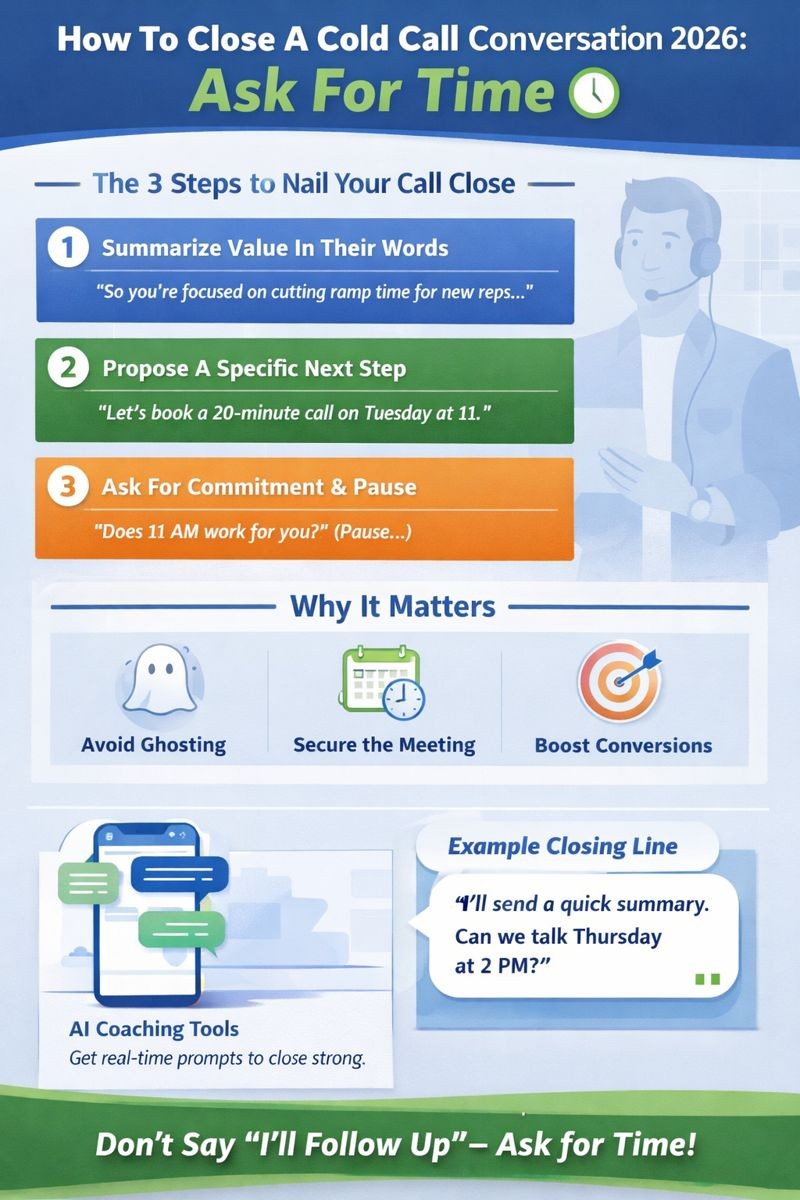
Close: Ask directly for a next step, often with one or two time options.
This structure matters because without it, calls feel random. One day you talk features for five minutes; the next day you push for a close too early. With a clear framework, you can look back at a call and see where it broke: opener, value, questions, or close.
At the same time, the framework is a guide, not a script you read word for word. Prospects can hear when you sound like a robot. The goal is to know the path well enough that you can adjust inside it—shorten your pitch if they sound rushed, lean into questions if they open up, or change your angle if a fresh pain surfaces.
In the rest of this article, we will use this framework to break down one strong and one weak cold call example. Watch where each part of the framework shows up and how small changes can flip the result.
Example Of A Cold Call That Goes Right: Breaking Down A Winning Script

Here is a cold call example that works. In this scenario, you are calling a VP of Sales at a mid-sized SaaS company that recently grew its SDR team.
Rep
“Hi Maria, this is Alex from Suade. Did I catch you with a quick minute, or are you headed into something right now?”Prospect
“I have a minute. What is this about?”Rep
“I saw on LinkedIn that you doubled your SDR team over the last six months and are still hiring. That is exciting growth, and it is actually why I reached out.”Prospect
“Yeah, it has been busy. Go on.”Rep
“I work with sales leaders at SaaS companies in a similar stage who want new reps to ramp faster and book more meetings from cold calls. Teams that use Suade see about twenty percent more meetings booked and cut ramp time by more than half.”Rep
“How are you coaching your newer reps on live calls right now?”Prospect
“Mostly call recordings and one-on-one feedback after the fact. It is hard to keep up.”Rep
“That matches what I hear from a lot of teams your size. The reason I am calling is that Suade gives SDRs a live guide during calls, with dynamic scripts and real-time prompts when they face objections. It also gives you full visibility into what is happening on those calls.”Prospect
“Real-time prompts? How does that work?”Rep
“While the rep is talking, Suade listens in, spots common patterns, and suggests better questions or objection responses on screen. New reps feel less alone, and leaders get consistent performance data without joining every call.”Rep
“Would it be worth twenty minutes next week to see how that would look with your team’s calls? We could walk through your current ramp plan and compare it to what our customers are seeing.”Prospect
“Sure, send something for Tuesday afternoon.”Rep
“Great, how does two thirty Eastern on Tuesday look? I will send a calendar invite with a short agenda.”
Why does this cold call example work?
The introduction is short and confident. No long “How are you today” and no apology for calling. Asking for “a quick minute” gives Maria a polite out but still moves the call forward.
The personalized opener lands because it is specific. Referencing SDR hiring and growth shows real research and links directly to likely coaching pains.
The value message is tied to results: more meetings and faster ramp, with numbers. Mentioning work with similar SaaS leaders adds quiet social proof.
The rep moves quickly into a discovery question (“How are you coaching…?”), pulling Maria into a two-way conversation and confirming the pain.
When Maria asks about real-time prompts, the rep gives a short, clear explanation and then goes straight to a direct close with a time suggestion and a concrete meeting purpose.
This is the level of call Suade is built to support. With pre-call script building, Suade can pull LinkedIn and company context into suggested openers. During the call, real-time AI coaching surfaces questions and objection responses on screen, even for new reps still finding their feet.
Where Cold Calls Go Wrong: The Most Common Failure Points

Most cold calls do not sound like that winning cold call example. They end in thirty seconds with a quick brush-off. In practice, the same trouble spots appear again and again:
Weak, generic openings: “Hi, this is John from X Company, how are you today?” said in a flat tone. Prospects hear this line constantly and brace for a pitch they did not ask for.
No personalization: Reps jump into canned claims like “We help businesses like yours” without naming the role, industry, or specific trigger event.
Talking too much: Long monologues about features and dashboards, with no pauses for questions or confirmation. Prospects sit in silence, wait for a gap, then escape with “Not interested.”
Poor objection handling: When they hear “No time” or “We already use something,” many reps either argue or give up, learning nothing from the moment.
Missing next steps: Even after a decent call, reps end with “I will send you more information” instead of a confirmed time on the calendar.
These patterns kill confidence, and research shows that warming up the cold call with preparation and personalization significantly reduces these failure points. When you are not prepared, it shows in your tone. You sound unsure, so the prospect trusts you less, which makes you even more nervous.
Modern tools such as Suade can listen for weak openings, missed questions, and soft closes in real time. The platform can nudge reps during calls and highlight these failure points in reviews, so repeat mistakes fade over time.
Example Of A Cold Call That Goes Wrong: Anatomy Of A Failed Script
Now let us look at a cold call example with the same VP of Sales target, but this time the call goes badly.
Rep
“Uh, hi, is this Maria? Is this a bad time?”Prospect
“Who is this?”Rep
“Oh, sorry, yeah, my name is John and I am calling from SalesBoost Software. We are a leading provider of sales acceleration technology for companies of all sizes, and we have a cutting edge platform that helps teams hit their numbers faster with advanced analytics and automation features.”Prospect
“I am really busy. What do you need?”Rep
“Right, of course. So, what we do is we integrate with your CRM and give you a single pane of glass for all your sales activity, including email, calls, and social, and we have dashboards for managers and advanced reporting and we have helped lots of companies increase their performance and streamline their operations.”Prospect
“We already have tools for that. I have to jump to another call.”Rep
“Okay, no problem, I can just send you some information if you want.”Prospect
“Sure, send it over.”Rep
“Great, thanks, have a good one.”
On the surface, this might sound normal, but it fails in almost every key area:
The opener invites a brush-off (“Is this a bad time?”) and forces Maria to ask who is calling.
The intro is full of generic phrases (“leading provider,” “companies of all sizes”) that could apply to anyone.
John launches into a long feature dump just after Maria says she is busy.
When he hears “We already have tools,” he accepts the objection at face value and retreats to “I can send you some information.”
There is no clear next step beyond an email that will likely never be read.
Compared to the earlier winning cold call example, the gaps are obvious: no research-based opener, no result-focused value, no early question, and no concrete close.
This is exactly where a platform like Suade can change outcomes. Dynamic scripts would push John to add a short, targeted opener. Real-time prompts could warn him that he is talking too long and suggest a discovery question. Post-call analysis would flag his weak objection handling and soft close so his manager could coach with specific examples.
Handling Common Objections: Where Calls Pivot To Success Or Failure
Objections are the turning point of most calls. The first “I do not have time” or “Just send me an email” either ends the call or opens a real conversation.
A simple pattern for handling objections:
Acknowledge what they said.
Show empathy so they feel heard.
Redirect with a short, focused statement.
Re-engage with a question or next step.
Examples:
“I do not have time.”
Weak: “I will be quick…” followed by more pitch.
Strong: “I get that—most leaders I call are between meetings. Would it be easier if we found ten focused minutes on Thursday morning, or is later in the week better?”“Just send me an email.”
Weak: “Sure, what is your address?” then hang up.
Strong: “Happy to send something. So I do not waste your inbox, could you share how you handle outbound calls now or what you would most want to improve?”“We already use something.”
Weak: “Okay, thanks anyway.”
Strong: “Makes sense, most teams I talk to have a tool in place. How well does that setup support your newer reps on live calls?”“I am not interested.”
Stronger reply: “Thanks for being direct. Before I let you go, is it that this is not a focus this quarter, or have you tried something similar that did not work?”
These answers show respect while still guiding the talk.
“People do not like to be sold, but they love to buy.”
— Jeffrey Gitomer
Getting to this level takes practice and pattern recognition. Suade can help by surfacing tested objection responses the moment phrases like “No time” or “Send an email” appear in the call transcript, speeding up learning for newer reps.
The Role Of Preparation: How Research Determines Call Outcomes
The quality of a cold call example is often decided before you ever hit dial. A few minutes of focused research can be the difference between a brush-off and a booked demo.
Before a high-value call, I usually:
Check the prospect’s LinkedIn: title, time in role, recent posts, and activity. Hiring posts, shared quotes, or topics they comment on can all become honest opening lines.
Scan the company website for press releases and product updates. Funding rounds, new offices, or big customer wins hint at where pressure is rising on revenue teams.
Look for trigger events: new executive hires, active SDR job posts, or expansion into new regions. Referencing these makes the call feel timely, not random.
Understand the basic go-to-market model: mid-market vs enterprise, product-led vs sales-led, and main growth levers. That context helps you frame the right value.
This prep improves every part of the call: opener, value message, questions, and your own confidence.
For teams making dozens of calls a day, deep manual research before every dial is tough. Suade’s pre-call script builder pulls data from sources like LinkedIn and turns it into suggested openers and talking points in seconds, making consistent preparation possible at scale.
Real-Time Adaptation: How Great SDRs Adjust Mid-Call
Even with solid prep and a clear script, no call follows the exact plan. Great SDRs treat the script as a guide, not a cage.
They adapt by:
Shortening the pitch when the prospect sounds rushed: “Sounds like you are between meetings. I can give you the core idea in thirty seconds and we can see if a deeper call is worth it. Fair?”
Leaning into discovery when the prospect asks detailed questions, using follow-ups and mirroring language to keep them talking.
Pivoting to sharp pain points the moment they are mentioned, tying benefits directly to what the buyer just said.
Staying calm on competitor mentions, asking what they like about the current tool and where it falls short, then positioning their product in that gap.
Doing all this live is hard, especially for new reps. Suade’s real-time coaching can suggest follow-up questions, remind reps to pause and listen, or prompt a clear close when the moment is right.
Post-Call Analysis: Learning From Both Success And Failure
Once you hang up, the call turns into data. Whether it ended with a quick “no” or a booked demo, there is always something to keep and something to change.
A simple post-call routine:
Note what worked: Where did the prospect lean in? After which line did they ask a question or share more detail?
Spot what failed: Where did their tone cool? Did they shut down after a long feature list or a rushed opener?
Save and repeat good lines: Openers, questions, or closes that work three times in a row should go into your standard script.
Retire weak lines: Phrases that consistently lead to silence or brush-offs need to be reworked or removed.
“Sales are contingent upon the attitude of the salesperson, not the attitude of the prospect.”
— W. Clement Stone
Call recordings help, but few managers have time to listen to every minute. Suade offers automated post-call analysis that tags key moments—objections, questions, closes—and links patterns to outcomes like booked meetings. Reps get specific coaching instead of vague “Ask more questions” feedback.
How AI-Powered Coaching Improves Cold Calling Performance

Cold calling is hard even for experienced reps. Preparation takes time, calls move quickly, and structured review is rare. Performance can swing a lot from one hour to the next.
Suade uses AI in a practical way to support the full cold call cycle in one place:
Before the call:
Dynamic script building pulls together research and best-practice flows. Suade suggests openers based on LinkedIn or company events, lines up a concise value message, and surfaces a short set of discovery questions. Reps start with a clear draft instead of a blank page.During the call:
Real-time coaching listens in and offers prompts. When a familiar objection appears, Suade suggests proven responses. If the rep has talked too long without a question, it nudges them to pause. As the conversation nears a close, it reminds them to ask directly for a meeting time.After the call:
Suade tracks metrics like talk-time balance, number of questions, objection types, and meeting outcomes. It then shows trends for each rep and across the team, so leaders see which scripts and behaviors tie to higher meeting rates.
Each part of this flow lines up with the failure points we already covered: generic openings, weak objection handling, and missed closes. Teams using Suade report more booked meetings and much faster SDR ramp times because everyone can see and reuse what their best cold call example looks and sounds like.
Key Metrics To Track For Cold Calling Success
You cannot improve a cold calling program on gut feel alone. A short list of simple metrics gives a clear picture of what is working and what is stuck:
Dial-to-connect rate: Percentage of dials that reach a live person. Low numbers point to list quality or calling times, not script issues.
Connect-to-conversation rate: How many live answers turn into real talks that last more than a few seconds. Weak openings and tone problems show up here.
Conversation-to-meeting rate: How often real talks end in a booked next step. Low numbers usually mean value, discovery, or close gaps.
Meeting show rate: How often booked meetings actually happen. Skips may mean the value was not clear or the time was not confirmed firmly.
Average call duration: Very short calls hint at early brush-offs; very long calls without meetings suggest rambling or soft closes.
Objection patterns: Which objections appear most often, and how often each still turns into a meeting.
Tracking this by hand is painful. Suade captures these numbers automatically and shows them in live dashboards. Reps see their own stats; leaders see where the funnel leaks and can target coaching at the right stage.
Building A Cold Calling Culture That Drives Consistent Results
Individual skills matter, but real growth comes when an entire team makes good cold calls day after day. That requires a clear culture around how the team treats calls, learning, and coaching.
Strong cold calling cultures usually share:
Clear expectations: Reps know both activity goals and quality standards (for example, number of questions per call and how often to ask for a next step).
Ongoing training: Calls are reviewed regularly. Teams share winning openers and objection responses. New hires learn from recordings of top performers.
Real-time support: Reps are not left alone when a hard objection hits. Tools like Suade act as an assistant coach on every call.
Psychological safety: Missed calls are treated as learning moments, not reasons for punishment. Reps are more willing to surface their toughest calls.
Recognition: Leaders highlight great calls, sharp questions, and steady improvement—not just closed deals.
Suade helps managers scale this culture. It brings the best patterns from top performers to the whole team, tracks progress for each rep, and gives leaders insight without requiring them to sit on every call.
Conclusion
We have walked through what makes a strong and weak cold call example, from the first words on the line to the final close. Structure, preparation, and tone shape the result long before the prospect says yes or no. A few avoidable mistakes in openings, objections, or next steps can sink even a decent call.
Cold calling will never be simple, and rejection will always be part of the job. But success is not about luck or natural charm. It is about smart research, a simple framework, active listening, and learning from every call.
Teams that treat cold calls as a craft—supported by data and coaching—ramp new reps faster, book more meetings from the same number of dials, and know exactly why their best calls work. Suade brings together pre-call script building, live AI coaching, and detailed post-call analysis so every rep has guidance at each stage.
Start by trying a few ideas from this guide on your next calls. Then look at how Suade can help your whole team move from guessing on each cold call example to following a clearer, proven path toward better results.
FAQs
What Is The Average Success Rate For Cold Calling?
For most outbound teams, the average success rate for cold calling sits around two to three percent when you measure calls that turn into booked meetings. That number shifts by industry, buyer level, and list quality. With strong training, sharper scripts, and better tools, top SDRs often reach six to eight percent or more. Even small gains at this stage add up quickly across hundreds of calls.
What Should I Say In The First 10 Seconds Of A Cold Call?
Those first ten seconds decide whether the prospect leans in or checks out. Aim to:
Say your name and company clearly.
Share a short, specific reason for your call.
For example: “Hi Jordan, this is Alex from Suade. I saw you just added five new SDRs to your team, and that is actually why I am calling.” This shows you know who they are and why now is a good time to talk. Avoid generic lines like “How are you today,” which signal a canned pitch.
How Can I Overcome Cold Calling Anxiety And Fear Of Rejection?
Nervousness before a block of calls is normal, and studies on brain drain show that the mere presence of distractions reduces cognitive capacity, which is why focused preparation is essential for managing call anxiety. I remind myself that a “no” is almost always about timing, fit, or the prospect’s workload—not me as a person. A few tips:
Prepare your opener, value message, and close so your brain has less to worry about.
Judge your day by how well you followed your process, not just by meeting count.
Use tools like Suade for real-time coaching, so you know you will get help if an objection catches you off guard.
Over time, as you see more patterns and stack small wins, the fear shrinks and calling feels more like a skill you control.
How Many Cold Calls Should An SDR Make Per Day?
Many teams expect an SDR to make 40–60 cold calls per day. The right number depends on your market, deal size, and how much research each account needs. In general, forty well-prepared calls beat eighty rushed, generic dials. Plan your day with clear blocks for research, calling, follow-up, and admin. With Suade handling prep and offering live coaching, reps often raise both call quality and volume without burning out.
How Do I Handle The “Just Send Me An Email” Objection?
When someone says “Just send me an email,” treat it as a polite attempt to end the call—not as a real request yet. A better approach is:
Agree: “Happy to send something.”
Add a question: “So I do not waste your time, could you share how you handle outbound calls now or what you would most want to improve?”
That one question often keeps them talking long enough for you to learn what they care about. Then send a short, focused email that:
Mentions your call,
Recaps their main point, and
Suggests a brief follow-up chat with one or two time options.
Tracking these moments inside Suade helps you see which phrasing actually turns that common objection into real next steps.